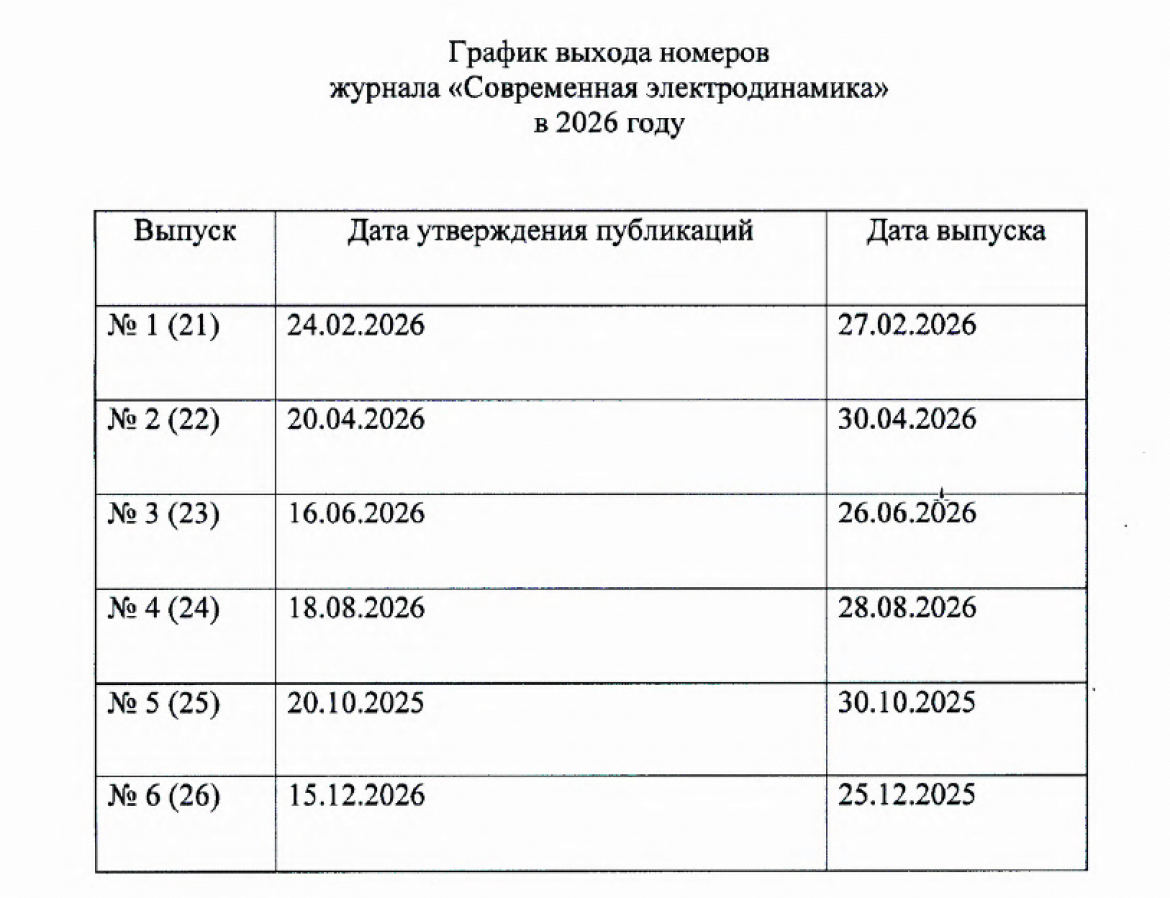
The editorial board of the mass media - the electronic scientific journal "Modern Electrodynamics" represented by the director of the Federal State Budgetary Institution of Science Institute of Theoretical and Applied Electrodynamics of the Russian Academy of Sciences Konstantin Nikolaevich Rozanov, acting on the basis of the Charter (hereinafter - the Editorial Board, Publisher), on the one hand, offers the uncertain a circle of persons (hereinafter referred to as the Author), on the other hand, hereinafter collectively referred to as the Parties, to conclude this Agreement (hereinafter referred to as the Agreement) on the publication of scientific materials (hereinafter referred to as the Article) in the electronic scientific journal “Modern Electrodynamics” on the conditions below.
1. Concepts and terms used in the Agreement
Author – an individual(s) whose creative work(s) the Article was created.
Acceptance of the Offer – full and unconditional acceptance of the Offer.
Journal – electronic scientific journal “Modern Electrodynamics”.
Application – an electronic appeal from the Author to the Publisher for placement of the Article in the Journal by sending the Author's material by e-mail to the address electrodynamics@mail.ru on the Internet information and telecommunications network.
Publisher – Federal State Budgetary Institution of Science Institute of Theoretical and Applied Electrodynamics of the Russian Academy of Sciences, which is the founder, editor and publisher of the Journal.
Metadata of the Article – materials in Russian and English intended for inclusion in scientific citation databases in accordance with the original version of the Article: title of the article; information about the authors (last name, first name, patronymic of the author (authors) in full, place of work of each author indicating the postal address, contact information (e-mail) for each author; abstract; keywords; subject heading: UDC or other library and bibliographic classification and subject indexes; bibliography (list of references).
Offer – this document (proposal to the Author) for the publication of the Article by posting it on the Journal page on the website http://itae.ru on the Internet.
Publication – placement of an Article in the Journal.
The Editorial Board of the Magazine is a creative team preparing the Magazine for publication.
The Editorial Council is an advisory body to the Editorial Board of the Journal.
An article is the result of fundamental and applied scientific research in the form of scientific material, review scientific material, scientific communication, bibliographic review on certain topics of scientific research, submitted by the Author for publication in the Journal.
Parties – Author and Publisher.
Requirements for articles – requirements for materials published in the Journal, posted on the Journal page on the website http://itae.ru on the Internet.
Service – placement (publication) of an Article in the Journal based on the Author’s Application.
2. General provisions
2.1. This Agreement defines the relationship between the Editorial Board and the Author (or other copyright holder) who accepted the public offer (Offer) to conclude this Agreement.
2.2. This Agreement in accordance with clause 2 of Art. 437 of the Civil Code of the Russian Federation is a public offer (hereinafter referred to as the Offer), complete and unconditional acceptance (acceptance) of which in accordance with Art. 438 of the Civil Code of the Russian Federation is considered to be the sending by the Author of his Author’s material to the Editorial Board by e-mail to the address electrodynamics@mail.ru on the Internet information and telecommunications network.
2.3. The electronic scientific journal “Modern Electrodynamics” is registered by the Federal Service for Supervision of Communications, Information Technologies and Mass Communications (Roskomnadzor), registration number El No. FS77-83666 dated July 26, 2022.
3. Subject of the Agreement (Offer)
3.1. Under this Agreement, the Author grants the Publisher, free of charge, for the duration of the copyright provided for by the legislation of the Russian Federation, a non-exclusive license to use the Article created by the Author for publication in the Journal.
3.2. The rights to use the Article transferred under this Agreement include, but are not limited to:
3.2.1. Reproduction of the Article or its separate part, as well as article metadata in Russian and English in any material form, including on paper and electronic media in the form of a separate work in magazines and/or databases (local or on the Internet) of the Publisher and/ or other persons at the discretion of the Publisher.
3.2.2. Distribution of the Article or its separate part, as well as metadata of the article in Russian and English on any medium as part of the Journal and/or databases of the Publisher or other persons at the discretion of the Publisher, or in the form of an independent work around the world on an open access basis or by subscription without payment of remuneration to the Author.
3.2.3. Bringing the Article or a separate part thereof, as well as article metadata in Russian and English, to the public in such a way that any person can access the Article from any place and at any time of their own choice (including via the Internet).
3.2.4. Issuance of permission to use the Article and its individual parts, as well as article metadata in Russian and English, to third parties with notification of this to the Author without payment of remuneration to the Author.
3.2.5. Processing, including translation of the Article (including into foreign languages), and use of the revised (translated) Article in the above ways.
3.2.6. Reservation by the Author of other rights not expressly transferred to the Publisher under this Agreement, including patent rights to any processes, methods or methods, etc., described by the Author in the Article, as well as rights to trademarks.
3.3. The territory in which the use of rights to the Article is permitted is not limited.
3.4. This Agreement comes into force in the event and from the moment the Editorial Board of the Journal makes a decision to accept the Article for publication.
3.5. Rights are transferred by the Author to the Publisher free of charge, and publication of the Article in the Journal does not entail any financial contributions to the Author.
3.6. If the Publisher decides to refuse to publish the Article in the Journal, this Agreement shall become invalid. The decision to refuse publication is sent to the Author at the email address specified in the Application.
3.7. The Publisher undertakes, during the term of the Agreement, to provide the Author with services related to the publication of the Article in the Journal.
4. General terms and conditions for the provision of services
4.1. The Publisher provides services to the Author only if the following conditions are met:
4.1.1. The author provided by email to electrodynamics@mail.ru all materials that meet the requirements of the Offer.
4.1.2. The Author accepted the Offer.
4.2. Services are provided to the Author free of charge.
4.3. If materials are provided by the Author in violation of the rules and requirements of this Offer, the Publisher has the right to refuse to post them.
4.4. During the term of the Agreement, the Publisher is not responsible for the unauthorized use by third parties of data provided by the Author.
5. Rights and obligations of the Parties
5.1. The author guarantees:
5.1.1. The author is the actual copyright holder of the exclusive rights to the article.
5.1.2. The rights granted to the Publisher under this Agreement have not been transferred previously and will not be transferred to third parties until the Article is published by the Publisher in the Journal.
5.1.3. The article contains all links to cited authors and/or publications (materials) provided for by current copyright law.
5.1.4. The Author has received all necessary permissions for the results, facts and other borrowed materials used in the Article, the copyright holder of which is not the Author.
5.1.5. The article does not contain materials that are not subject to publication in the open press in accordance with the current legislative acts of the Russian Federation, and its publication and distribution will not lead to the disclosure of secret (confidential) information (including state secrets).
5.1.6. The Author informed the other Co-authors regarding the terms of this Agreement and received the consent of all Co-authors to conclude this Agreement on the terms provided for in the Agreement.
5.2. The author undertakes:
5.2.1. Submit the manuscript of the Article in accordance with the Requirements for Articles specified on the Journal page on the website http://itae.ru on the Internet.
5.2.2. Do not use for commercial purposes or in other publications without the consent of the Publisher an electronic copy of the Article prepared by the Publisher.
5.2.3. In the process of preparing the Article for publication, the Author undertakes:
a) make corrections to the text of the Article specified by the reviewers and accepted by the Editorial Board of the Journal, and/or, if necessary, at the request of the Publisher and the Editorial Board, modify the Article;
b) read the proof of the Article within the time limits provided for by the Journal’s publication schedule;
c) make only the minimum of changes to the proof of the Article that are associated with the need to correct errors made in the original Article and/or introduce factual and opportunistic changes.
5.3. The Author has the right to transfer to third parties an electronic copy of the published Article provided to him by the Publisher in accordance with clause 5.4 of this Agreement, in whole or in part, for inclusion of the Article in databases and repositories of scientific information in order to promote academic or scientific research or for information and educational purposes, provided that links to the Author, Journal and Publisher.
5.4. The publisher undertakes:
5.4.1. Publish in printed and electronic form the Author's Article in the Journal in accordance with the terms of this Agreement.
5.4.2. By decision of the Editorial Board of the Journal, if necessary, provide the Author with a proofreading of the layout of the Article and make reasonable corrections by the Author.
5.4.3. Provide the Author with an electronic copy of the published Article to the Author’s email address within 15 working days from the date of publication of the Journal issue.
5.4.4. Comply with the rights of the Author provided for by current legislation, as well as protect them and take all necessary measures to prevent violation of copyright by third parties.
5.5. The publisher has the right:
5.5.1. Carry out technical and literary editing of the Article without changing its main content.
5.5.2. Conduct an examination of the Article and propose to the Author to make the necessary changes, until which the Article will not be published in the Journal.
5.5.3. For any subsequent authorized use by the Author (and/or other persons) of the Journal and/or Article (including any of its individual parts, fragments), require these persons to provide a link to the Journal, Publisher, Author or other copyright holders, title of the Article, the Journal number and year of publication indicated in the Journal.
5.5.4. Place preliminary and/or advertising information about the upcoming publication of the Article in the media and other information sources.
5.5.5. Establish rules (conditions) for accepting and publishing materials in the Journal. The Editorial Council of the Journal, headed by the Editor-in-Chief, has exclusive rights to select and/or reject materials sent to the Editorial Board of the Journal for the purpose of their publication. The manuscript (material medium) sent by the Author to the Editorial Board of the Journal cannot be returned. The Editorial Board of the Journal does not enter into correspondence regarding issues of rejection of the Article by the Editorial Board of the Journal.
5.5.6. Temporarily suspend the provision of services to the Author under the Agreement for technical, technological or other reasons that impede the provision of services, until such reasons are eliminated.
5.5.7. Suspend the provision of services under the Agreement unilaterally out of court in the following cases:
a) if the Article does not correspond to the subject of the Journal (or any part thereof), or the material presented is insufficient for independent publication, or the design of the Article does not meet the requirements;
b) violation by the Author of other obligations assumed in accordance with the Offer.
5.5.8. Make changes to the Offer in the manner prescribed by the Offer.
5.6. In all cases not specified or provided for in this Agreement, the Parties are obliged to be guided by the current legislation of the Russian Federation.
6. Acceptance of the Offer and conclusion of the Agreement. Contract time
6.1. Acceptance of the Offer by the Author creates an Agreement concluded in writing (Articles 438 and 1286.1 of the Civil Code of the Russian Federation) on the terms of the Offer.
6.2. This Agreement comes into force from the moment of its conclusion and is valid for 5 years.
6.3. If neither Party sends written notice of termination of the Agreement to the other Party no later than two months before the end of the prescribed five-year period, then the period of validity of the Publisher's rights to the Works is automatically extended for a similar period. The number of extensions is not limited.
6.4. The validity period of the Agreement cannot exceed the period of validity of the exclusive rights to the Article in accordance with the legislation of the Russian Federation.
6.5. Upon transfer (alienation) of the exclusive right to a work by the Author to a third party, this Agreement does not terminate.
7. Procedure for amending and terminating the Agreement
7.1. The Publisher has the right to unilaterally change the terms of this Agreement, in advance, no less than 10 (ten) calendar days before the entry into force of the corresponding changes, notifying the Author about this by sending a notice via e-mail to the Author's e-mail address specified in the Author's Application. Changes take effect from the date specified in the relevant notice.
7.2. If the Author disagrees with changes to the terms of this Agreement, the Author has the right to send the Publisher a written notice of refusal of this Agreement by sending a notification to the official email address of the Editorial Board electrodynamics@mail.ru.
7.3. This Agreement may be terminated early by agreement of the Parties at any time, as well as on other grounds provided for in this Agreement.
7.4. The Author has the right to unilaterally refuse to fulfill this Agreement by sending the Publisher a corresponding notice in writing at least 20 (twenty) calendar days before the expected date of publication of the Author’s article in the Journal.
7.5. Termination of the Agreement for any reason does not relieve the Parties from liability for violations of the terms of the Agreement that arose during its validity.
8. Responsibility of the Parties
8.1. For failure to fulfill or improper fulfillment of their obligations under the Agreement, the Parties are liable in accordance with the current legislation of the Russian Federation.
8.2. All information provided by the Author must be reliable. The author is responsible for the accuracy and completeness of the information he transmits to the Publisher. When using false information received from the Author, the Publisher is not responsible for the negative consequences caused by its actions based on the false information provided.
8.3. The author bears full responsibility for compliance with the requirements of the legislation of the Russian Federation on advertising, on the protection of copyright and related rights, on the protection of trademarks and service marks, on the protection of consumer rights.
8.4. The Publisher does not bear any liability under the Agreement for any actions that are a direct or indirect result of the actions of the Author and for any losses of the Author, regardless of whether the Publisher could have foreseen the possibility of such losses or not.
8.5. The publisher is exempt from liability for violation of the terms of the Agreement if such violation is caused by force majeure circumstances (force majeure), including actions of government authorities (including the adoption of legal acts), fire, flood, earthquake, other natural disasters, lack of electricity and/or computer network failures, strikes, civil unrest, riots, any other circumstances.
9. Dispute resolution procedure
9.1. Disputes and disagreements will be resolved by the Parties through negotiations, and in case of failure to reach agreement, in accordance with the current legislation of the Russian Federation.
9.2. If there are unresolved disagreements between the Parties, disputes are resolved in court at the location of the Publisher in accordance with the current legislation of the Russian Federation.
10. Other conditions
10.1. Any notifications, messages, requests, etc. (with the exception of documents that must be sent in the form of original originals in accordance with the legislation of the Russian Federation) are considered received by the Author if they were transmitted (sent) by the Publisher through the website http://itae.ru (including by publication), by electronic mail by mail specified in the Application and through other communication channels. The parties recognize the legal force of notifications, messages, requests, etc., transmitted (sent) in the methods indicated above.
10.2. In the event that claims are presented to the Publisher related to the violation of exclusive copyright and other intellectual property rights of third parties during the creation of the Article or in connection with the conclusion by the Author of this Agreement, the Author undertakes:
10.2.1. Immediately upon receipt of the Publisher’s notification, take steps to resolve disputes with third parties, if necessary, enter into legal proceedings on the Publisher’s side and take all actions within its power to exclude the Publisher from the list of defendants.
10.2.2. Reimburse the Publisher for legal costs incurred, expenses and losses caused by the application of measures to secure the claim and execution of a court decision, and amounts paid to a third party for violation of exclusive copyright and other intellectual property rights, as well as other losses incurred by the Publisher in connection with the Author’s failure to comply with the guarantees provided them under this Agreement.
10.3. In accordance with Art. 6. Federal Law “On Personal Data” No. 152-FZ dated July 27, 2006, during the period from the moment of conclusion of this Agreement and until the termination of the obligations of the Parties under this Agreement, the Author expresses consent to the processing by the Publisher of the following personal data of the Author: last name, first name, patronymic; individual taxpayer number (TIN); Date and place of birth; information about citizenship; details of identity documents; addresses of the place of registration and actual place of residence; email addresses; postal address with zip code; contact phone numbers; fax numbers; information about places of work.
10.4. The Publisher has the right to process the specified personal data for the purpose of fulfilling this Agreement, including providing information and reference services to the Author. Processing of personal data means actions (operations) with personal data, including collection, systematization, accumulation, storage, clarification (updating, changing), use, distribution (including transfer to third parties), depersonalization, blocking and destruction of personal data in accordance with with the current legislation of the Russian Federation.
10.5. The Author has the right to withdraw consent to the processing of personal data listed in clause 10.3 by sending the Publisher a corresponding notification in cases provided for by the legislation of the Russian Federation. Upon receipt of this notification, the Publisher has the right to suspend the provision of services.
10.6. The author voluntarily provides information about himself (and about each of the Co-authors - by prior agreement with them) to the editors of the Journal, including: last name, first name, patronymic, academic degree, academic title, position, place of work (name and postal address of the organization) , work phone number and email address for the purpose of their open publication in the Journal along with the publication of the article.
11. Legal address and details of the Publisher
Institute for Theoretical and Applied Electromagnetics of RAS, INN 7713020549, KPP 771301001, OGRN 1027739263441.
Address: 125412, Moscow, Izhorskaya street, 13 building 6.