
Contents
Section 1. Topics on experimental electrodynamics
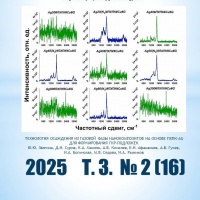
Technology of vapor deposition of nanocomposites based on PCPX-AG for the formation of SERS substrates
J.Yu. Zvyagina, D.I. Surov, K.A. Mailyan, A.V. Kiselev, K.N. Afanas'ev, A.V. Gusev, I.A. Boginskaya, M.V. Sedova, I.A. Ryzhikov
Abstract
In this work, we tried out a multi-step technology based on cryochemical synthesis, galvanic and lithographic methods, and vacuum sputtering to fabricate SERS-active substrates with complex micro-and nano-scale structure. The substrates were formed from the polymer poly-chloro-p-xylylene and two SERS-active plasmonic metals: silver and copper. Glass slides were used as a base. The final substrates were a sandwich structure of silver/poly-chloro-p-xylylene/copper, where a polymer layer of about 13 $\mu$m thickness is enclosed between two layers of SERS-active plasmonic metals, silver and copper, on a glass base. The substrates differed in the thickness of the silver layer as well as in the conditions of its application: at the temperature of liquid nitrogen and at room temperature. The obtained substrates are characterized by a periodic structure consisting of micron-sized cylindrical protrusions, whose morphology at the nanoscale differs from the morphology of the surface between the cylinders, which is confirmed by the results of SERS mapping. The possibility of using such substrates for recording SERS spectra of low-molecular substances is demonstrated using 4-mercaptophenylboronic acid (4-MPBA) as an example. The dependence of the SERS signal enhancement on the nanocomposite microstructure and silver thickness is determined. Ellipsometric studies confirm the existence of plasmon resonance on the obtained substrates, which is confirmed by the presence of SERS effect on all samples.
Keywords: SERS spectroscopy, SERS-active substrates, metal-polymer nanocomposites, 4-MPBA
Section 2. Topics on computer simulation in electrodynamics
A method for optimizing coating parameters of the inner surface of a metal cavity
V.N. Kisel, A.S. Maslov
Abstract
Reflection from cavities often determines the maximum level of the backscatter field of various objects. This scattering can be reduced by deploying coating over the walls of the cavity, so the optimal choice of coating parameters is of great practical importance. The corresponding theoretical and computational studies involve significant computer resources, which can be reduced by applying suitable approximations and special techniques. For example, an absorbing magnetodielectric coating is usually well described by an equivalent surface impedance, the use of which drastically reduces the complexity of calculations and simplifies optimization. The article discusses a method for selecting the surface impedance of the coating of cavity walls, the use of which allows for maximum energy absorption in the coating material and corresponding minimization of the level of backward radiation.
Keywords: diffraction, energy, cavity, radar absorbing coating, reflection coefficient
Section 3. Metodological notes
On units of measurement in electrodynamics
M.G. Ivanov, V.A. Dudchenko
Abstract
The system of units of measurement is determined by specifying the base units of measurement and selecting the coefficients in the equations. This makes it possible, even by setting seven base units of measurement in the SI system, to change the system of units in such a way that it corresponds to the symmetries of electrodynamics. With this choice, all fields E, D, B, H acquire the same dimension and are measured in units of V/m. Writing Maxwell's equations becomes similar to writing in the Gaussian CGS system. At the same time, the units of measurement for electrical circuits remain the same as in the conventional SI system.
Taking into account the established practice when only the SI system is used for electrical circuits, and many physicists prefer the Gaussian system for electrodynamics, this compromise system of units of measurement seems preferable for most applications.
A textbook [3] on the course "Mechanics and Field Theory"is currently being prepared for publication, which consistently uses this system of units.
Keywords: SI, International System of Units, electrodynamics, physics and technology system of units, special relativity

Editorial address: 13 b. 6, Izhorskaya st.,
This site respects your rights and maintains confidentiality when filling out, transmitting and storing your confidential information.
Placing an application on this site means your consent to the processing of data and the further transfer of your contact information to our company.
Personal data means information related to the subject of personal data, in particular the name, contact details (email address) and other data classified as personal data by Federal Law of July 27, 2006 No. 152-FZ “On Personal Data.”
The purpose of processing personal data is to inform about the services provided by our company.