
Contents
Section 1. Topics on interaction of an electromagnetic field with materials
Diffraction on periodic structures made of conductive nanobars
V.V. Starostenko, A.N. Kofanov, M.M. Padalinskiy, I.S. Fitaev, A.D. Grozovskiy
Abstract
In recent years, advances in the production and synthesis of materials have made it possible to create three-dimensional nanoscale structures with periodic architecture, which are often referred to as nanolattices. By changing the parameters and placement of the lattice elements (bars), it is possible to adjust the properties of nanolattices such as absorption, reflection, etc. This allows us to obtain a number of practically important characteristics that are difficult to achieve when using full-size coatings, and therefore promising for use as microwave paths, electronic modules, antenna technology, absorbing coatings and many other areas. Since there are many possible configurations of nanogrid elements, numerical calculations are necessary for an effective comparative analysis. Numerical modeling in COMSOL, CST Studio, and HFSS was used to model devices with nanolattices. In this paper, the phenomenon of diffraction on conducting structures is considered in order to study the power dependences of reflection, transmission, and absorption coefficients on nanogrid parameters at normal incidence of a plane wave for perpendicular and parallel polarizations relative to the bars of the lattice.
Keywords: nanostructures, nanolattices, optical coefficients, incident wave, electromagnetic waves
Section 2. Topics on experimental electrodynamics
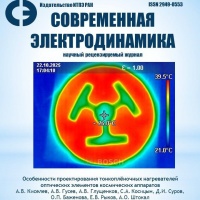
Design features of precision thin-film heaters for optical elements of spacecraft
A.V. Kiselev, A.V. Gusev, A.V. Gluschenkov, S.A. Kositsyn, D.I. Surov, O.P. Bazhenova, E.V. Rykov, A.O. Shtokal
Abstract
The importance of ensuring a stable thermal operating mode for high-precision instruments on spacecraft, such as optical systems, was noted, and it was indicated that heaters for optical elements on spacecraft should have the lowest possible gas emission and uneven temperature distribution across their surface. The results of numerical modeling and experimental development of the design of a thin-film heater intended for thermal regulation of the optical element of a spacecraft are presented. Numerical modeling was performed using the COMSOL Multiphysics software package, which made it possible to describe in detail the electrical and thermal processes in the object under research. The conducted investigations confirmed the qualitative coincidence of the obtained temperature fields with the results of modeling with acceptable quantitative differences due to the simplification of heat transfer conditions in the model. It is shown that the use of a meander structure and the choice of materials in the formation of heater layers allows for the required temperature uniformity on the heater surface to be ensured with an accuracy of up to 1.5 0C. At the same time, outgassing from the heater surfaces is acceptable for optical elements of spacecraft operating in a wide range of wavelengths. The obtained results can be used for the development and improvement of thermal control systems for optical elements in space technology.
Keywords: meander, heater, thermoregulation, coatings, outgassing

Editorial address: 13 b. 6, Izhorskaya st.,
This site respects your rights and maintains confidentiality when filling out, transmitting and storing your confidential information.
Placing an application on this site means your consent to the processing of data and the further transfer of your contact information to our company.
Personal data means information related to the subject of personal data, in particular the name, contact details (email address) and other data classified as personal data by Federal Law of July 27, 2006 No. 152-FZ “On Personal Data.”
The purpose of processing personal data is to inform about the services provided by our company.