
Contents
Section 1. Topics on experimental electrodynamics
Possibilities of confidential messages protection in data transmission systems using phenomenon of dynamic chaos and optical vortexes
L.V. Cherckesova, N.V. Boldyrikhin, O.A. Safaryan, I.A. Alferova
Abstract
This article considers possibility of con dential (secret) communication systems creating using deterministic chaos and optical vortices phenomena, and assesses their characteristics from information security point of view. Possibilities of nonlinear dynamic cryptology methods using for solving data security problems are shown. Features of generation, synchronization, modulation and control chaotic oscillations when using in data transmission systems are revealed. Conditions for deterministic chaos modes occurrence in dynamic nonlinear parametric system are determined. It is shown that system roughness property turns out to be great advantage when solving problems of con dential (secret) communication systems constructing using nonlinear parametric generators operating in chaotic mode. Attractors phase portraits at parameter plane characteristic points are shown.
As optical range deterministic chaos generator, it is proposed to use one of nonlinear parametric generator varieties - nonlinear ring interferometer - resonator, on base of which detector of topological charge of vortex has been developed, intended for intensity of light beam measuring. Mathematical models of processes occurring in nonlinear ring interferometer are proposed, taking into account static electric eld with di usion relationship. Chaotic communication various schemes are compared, using example of ring ber-optic systems based on erbium laser. It is recommended to modify "encryptor"/ "decryptor" scheme by adding second circuit in transmitter and receiver, to increase the secrecy of transmitted steganographic messages in system with hidden signal nonlinear mixing.
With increasing dynamic nonlinear parametric system parameters number, on which its electrodynamics depends, when using system as encryptor, cryptographic keys number increases.
As calculations show, when delay time mismatch value of signal passing between transmitter and receiver circuits of chaotic communication system is reduced, distortions amount occurring in decrypted message is reduced also. Analysis of disturbing factors impact on data transmission system characteristics is carried out. They are: non-identity (mismatch) of transmitter and receiver components parameters; nonlinear distortions in communication channels, noise and interference; as well as elements unevenness of amplitude-frequency characteristics. After comparing various systems for protecting transmitted data in dynamic chaotic communication systems, and comparing results obtained, chaotic communication systems existing today modern classi cation is given.
Keywords: silver island films, critical behavior, neuromorphic computing, Levy distribution
Section 2. Topics on interaction of an electromagnetic field with materials
Measurement of light-scattering properties of fluoroplastic in the range of 400 - 800 nm
A.P. Tarasov, D.A. Rogatkin
Abstract
The work is devoted to the study of optical properties of fluoroplastic F-4 (polytetrafluoroethylene) as a basic light-scattering material for optical skin phantoms. Three samples of fluoroplastic with thicknesses of 3, 5 and 10 mm were studied using backscattering spectroscopy methods in the visible wavelength range (400-800 nm). The coefficient of total diffuse reflection and the relative backscattered flux recorded at different distances from the light source were obtained.
Keywords: optical phantom, skin, optical properties, fluoroplastic, polytetrafluoroethylene, reflectivity coefficient
Section 3. Topics on computer simulation in electrodynamics
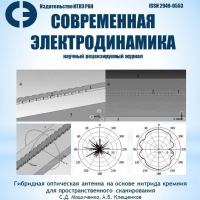
Hybrid silicon nitride based optical antenna for spatial scanning
S.D. Moshichenko, A.B. Kleshenkov
Abstract
Optical integrated circuits (IC) are promising devices applicable in many areas. Such devices might be used as replacement of photoemitting diodes, photodetectors, solar energy converters, detectors etc. A particular emphasis should be given to spatial scanning where an optical IC replaces mechanical and mechano-electrical scanning methods. Optical antennas (OA) are optical IC structures coupling guided and free-space modes by breaking total internal re ection in optical waveguides. Low refractive index contrast OAs might have large linear aperture narrowing a radiation pattern. Such OAs conclude 1D phased array often, in which a wavelength tunning steers main beam in OA aperture plane, and a phase shift does it in transverse one. In this work, several common OAs designs are reviewed, and their properties are described. Onwards, a new silicon nitride hybrid asymmetric double stripe OA design is proposed. An infrared (1.55µm) band modelling results presented denote that model proposed has 30.4 dBi directivity, -32.3 dB SLL, 0.2° and 23.9° FWHM in longitudinal and transverse planes respectively, and 9.3° longitudinal eld of view (FOV) on 1.5-1.6µm wavelength tuning.
Keywords: optical antenna, integrated optics, silicon nitride, optical phased array, spatial scanning, LIDAR

Editorial address: 13 b. 6, Izhorskaya st.,
This site respects your rights and maintains confidentiality when filling out, transmitting and storing your confidential information.
Placing an application on this site means your consent to the processing of data and the further transfer of your contact information to our company.
Personal data means information related to the subject of personal data, in particular the name, contact details (email address) and other data classified as personal data by Federal Law of July 27, 2006 No. 152-FZ “On Personal Data.”
The purpose of processing personal data is to inform about the services provided by our company.