
СОВРЕМЕННАЯ ЭЛЕКТРОДИНАМИКА
MODERN ELECTRODYNAMICS ISSN 2949-0553
Contents
Section 1. Topics on interaction of an electromagnetic field with materials
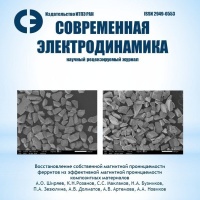
A.O. Shiryaev, K.N. Rozanov, S.S. Maklakov, N.A. Buznikov, P.A. Zezyulina, A.V. Dolmatov, A.V. Artemova, A.A. Novikov
Abstract
The paper investigates the dynamic magnetic properties of various ferrite grades and composite materials based on them. Particles with the same shape but different sizes were obtained from the bulk ferrites under study. The permeability of the ferrite-powder composites was studied as a function of frequency, inclusion size, and concentration. Additionally, the dynamic permeability of the ferrites under an external magnetic field was investigated. The applicability of various mixing rules to the measured permeability of the studied composite materials was analyzed. Using the Odelevsky formula, the intrinsic permeability of ferrite inclusions of various sizes and grades was determined. It was found that the intrinsic permeability of the inclusions depends on their size and differs from the measured permeability of bulk ferrites, which is inconsistent with generally accepted effective medium theories. However, the application of an external magnetic field eliminates the difference in permeability between particles of different sizes. It was shown that a correct description of the properties of composite materials requires accounting for the difference between the permeabilities of a small particle and a bulk material. The discrepancy observed in this work is attributed to the difference in the resonance frequencies of the domain walls.
Keywords: permeability, ferrites, composite materials, mixing rules, ferromagnetic resonance
I.V. Komarov, A.V. Osipov, P.A. Zezyulina, N.A. Buznikov, P.A. Ivanov, S.A. Maklakov, S.S. Maklakov, A.O. Shiryaev, A.N. Lagarkov, K.N. Rozanov
Abstract
The magnetostatic properties and dynamic magnetic permeability of amorphous Co67Fe7B26 films on a flexible substrate were investigated in a wide range of film thicknesses from 190 to 1400 nm. The permeability of the films was measured using the coaxial technique in the frequency range of 0.1 to 10 GHz. The results of magnetostatic and microwave measurements showed that the studied films have in-plane uniaxial magnetic anisotropy. It is shown that the decrease in the peak amplitude of the imaginary part of the dynamic permeability with an increase in the film thickness is due to the influence of eddy currents. The influence of mechanical stresses appearing during bending of the studied films on the dynamic permeability is analyzed. It is established that the magnetoelastic effect significantly changes the frequency dependence of magnetic permeability, since mechanical stresses affect the distribution of static magnetization in films. A qualitative model taking into account the influence of tensile and compressive stresses on the measured dynamic permeability of films is proposed. It is shown that for the studied films, the magnetoelastic anisotropy field caused by mechanical stresses in a rolled sample is higher than the magnetic anisotropy field in a flat film. The results obtained may be useful for microwave applications of amorphous CoFeB films.
Keywords: CoFeB films, flexible substrate, dynamic permeability, ferromagnetic resonance, magnetic anisotropy
Section 2. Topics on theoretical electrodynamics
On ferromagnetic resonance in a ferromagnetic conducting sphere
A.O. Sboychakov
Abstract
This paper studies the influence of the skin-effect on the high-frequency properties of the ferromagnetic conducting spherical particle. Ferromagnetic particle is assumed to be uniformly magnetized in the external dc magnetic field. In this study we use the approach based on solving the Maxwell equations in quasi-static approximation for a given particle’s ac magnetization, followed by solving the Landau-Lifshitz-Gilbert equations. This work studies in detail the low skin-effect limit, when the skin depth ls is greater than the particle’s radius R. In the limit ls/R≫1 a simple analytical formula for the particle’s susceptibility is derived.
Keywords: high-frequency permeability, skin-effect
Section 3. Topics on experimental electrodynamics
One-port calibration procedure using an ideal short load and a nonideal sliding load
D.A. Petrov, P.A. Ivanov, K.N. Rozanov
Abstract
Microwave measurements performed using a vector network analyzer require calibration of the measurement port to correct for systematic measurement errors. In many practical cases, however, it is difficult or impossible to realize all three calibration standards — short, open, and matched load — commonly employed in conventional one-port calibration and required for complete characterization of the systematic errors of the measurement port. For example, a broadband open-circuit standard cannot readily be implemented in rectangular waveguide measurement systems or in open measurement lines based on horn antennas. In a number of such applications a reflecting element can be displaced along the direction of electromagnetic wave propagation. Changing the position of this element changes the phase of its reflection coefficient and therefore makes it possible to obtain several independent calibration measurements. Conventional sliding waveguide short-circuit standards, however, do not necessarily provide perfect reflection from the movable reflecting element. Consequently, its reflection coefficient cannot in general be assumed to be equal to −1, and its reflection phase may also be unknown. In this work, a method combining two different types of calibration standards is proposed for performing a complete one-port calibration. The first standard is an ideal zero-offset short circuit, which can be readily implemented in waveguide and horn-antenna measurement systems using a flat, polished metallic plate. The second standard is a sliding load containing a nonideal reflecting element with an a priori unknown reflection coefficient and providing several calibration measurements at different positions. Thus, the proposed calibration procedure requires only two mechanically distinct calibration standards instead of the conventional three. In addition, the method makes it possible to reduce the influence of waveguide misalignment on the calibration results.
Keywords: one-port calibration, waveguide, sliding load, short load

Editorial address: 13 b. 6, Izhorskaya st.,
This site respects your rights and maintains confidentiality when filling out, transmitting and storing your confidential information.
Placing an application on this site means your consent to the processing of data and the further transfer of your contact information to our company.
Personal data means information related to the subject of personal data, in particular the name, contact details (email address) and other data classified as personal data by Federal Law of July 27, 2006 No. 152-FZ “On Personal Data.”
The purpose of processing personal data is to inform about the services provided by our company.